
First Week
09/05/2021
Fashion
This week I studied Halston, an internationally renowned designer who met his abrupt demise after a long successful career.
I watched his documentary and the narrative series recently released on Netflix. Halston died before I was born, but his impact has lasted long after his death. Throughout the films, I learned about Halston’s humble beginning. He was born in Des Moines, Iowa, and spent his childhood trying to be accepted in his identity and making hats for the women in his family. He became a successful milliner and eventually evolved into a fashion designer. Halston is known for his admiration of women and making clothes for women not just for adornment. Halston rarely made clothes that were uncomfortable or almost impossible to wear for extended periods of time unlike designers like Dior. Halston’s demise began due to his personal life and poor business decisions. He signed a contract with a corporation that in exchange for owning his name, he would receive virtually unlimited business expenses and one million dollars a year. Halston was the first designer to sell clothes in high and low-end stores like Bergdorf’s and JC Penny. Halston paved the way for present-day designers like Missoni and Christopher John Rodgers to have clothes carried in high and low-end clothing stores. Halston realized he could not keep up with the demand to design clothes for JC Penny on his own and fell behind in creating designs. He also entered into an abusive relationship and began living a reckless and promiscuous lifestyle. He abused substances and contracted a terminal illness. Halston abused substances to deal with the stress and emotional problems he suffered being a gay man in society. Throughout his childhood, he had a tumultuous relationship with his father due to his sexuality. The documentary concluded his abusive relationship with his lover and himself were comfortable for him because they replicated the relationship he had with his father. When he fell behind on his demands, the cooperation he worked for took his name and began mass-producing clothes without Halston’s guidance. Halston realized he sold his name too cheap and that it was priceless.
As a designer, from Halston, I learned that it is important to be aware of your worth in the beginning. Halston taught me that my name is priceless and there is no price high enough to surrender my likeness to anyone. I learned the cooperate side of the fashion industry and how important it is to have a business partner to make sure I earn the compensation I deserve. Halston taught me to accept who I am even when I am not accepted or understood by the people who I seek acceptance from the most. I could not imagine how difficult it was for him not to receive acceptance from his father and all the shame that came with being gay. Halston taught me to seek help for the problems in my life and not seek substance abuse or men to fill a void. He also taught me to design clothes for women, not for their adornment. I want my clothes to be something women can feel empowered in, not confined. I feel like if Halston had sought help for the emotional trouble he faced he would still be with us today. Eventually, Halston’s name was bought back and I know that if he would’ve lived, he would’ve been able to buy his name back himself. Halston’s life is an example of perseverance and resilience.
Business
I met with Markesha Henderson and her team this week to discuss the goals we will complete in the future. Markesha has a long list of goals and opportunities for me to complete. First, I am using the preexisting apparel in the mezzanine to sell some leftover clothes to students. I am going to do visual merchandising to display the clothes during the upcoming game on October 8th. For the past couple of weeks, I have been going through the apparel to draft an inventory for the official sale on October 8th. I have been deciding which clothes I want to sell and how I want them to be displayed. During the sale, she wants me to talk to customers and gather data on what their wants and needs are as consumers. She wants me to use the data to develop a new line.
We will also be doing a focus group with the athletes to determine what styles they want to be produced and offered. I want to specialize in making clothes that are cut for their body types and the demands the sports take on their bodies.
I will be entering into a contract with the school to have an official agreement to receive adequate compensation for my work. (Halston Tip)
I will be designing clothes for athletic signing day in the spring and other events throughout the year where the school needs official apparel.
The goal for the college is to have the Agnes Scott name synonymous with a brand that people have a sense of pride wearing. So that even people who are not students or alumni will identify with the brand of Agnes Scott College and want to wear the clothes. The college also wants to instill school pride among the student body and alumni.
Agnes wants me to produce signage and press to promote their apparel. I intend to create a commercial and do a photoshoot using my filmmaking skills.
Markesha will also be giving me access to data in the past to see the history of how the apparel has sold. She wants me to have a better understanding of what has worked in the past and how I can implement and make changes to the existing model. She also wants me to gather data to have a presentation at the end of the semester.
She also wants me to meet with executives in similar positions like the company Fanatics and other athletic wear sales brands to network and learn about the industry.
I will be working at the Mercedes Benz externship to sell apparel at the Mercedes Benz stadium. I will learn about visual merchandising and how to position the merchandise and what displays to use to attract consumers. I will also work personally with customers to learn customer service.
I will also be working with a Scottie who is a personal trainer and influencer to assist me with the brand.
My overall goal is to become the predominant supplier for Agnes Scott college apparel. I want to have a team of Scotties in different disciplines like business, graphic design, etc to help me produce gear for Agnes Scott college indefinitely. Next, I would like to dominate every college in the United States starting with small liberal arts colleges that have little time and resources to spend redesigning their athletic apparel.
Second week
9/12/2021
Fashion
Isaac Mizrahi’s documentary, Unzipped, was a refreshing view inside the designer’s process. Most documentaries I have viewed in the past showed an overproduced and glamourized reflection of the design process. Unzipped revealed the realities that surround the designer’s experience. Mizrahi went on a quest to find inspiration and directly sought out a whole collection from one scene in a movie with a woman in a fur coat. Mizrahi constantly referenced films and used them as his direct source of inspiration. Like Mizrahi, there is a continuity between designers using films as a source of inspiration like Halston, studied last week. The relationship between fashion designers and films makes me further aware of the connection between the two. I am defined as a fashion and film studies major. Many people get confused when I tell them I am merging the two disciples into one profession, but Mizrahi and Halston are two of many examples of how the two industries coexist. Mizrahi began the season reviewing critics’ reviews and went through an emotional rollercoaster. Mizrahi and Halston both had a difficult time reading reviews in the documentaries. I learned that no matter how successful one is, criticism can cause feelings of inadequacy and self-doubt. That taught me to be careful how much criticism I review and the relationship criticism has with my self-worth. Mizrahi is the first designer I’ve seen in a long time actually sketch anything. It was refreshing to see his ideas come from his brain directly onto the paper. It inspired me to continue with my drawing studies so I can sketch my designs. Mizrahi went through a variety of emotional highs and lows throughout the collection. The documentary showed the emotional toll a profession in fashion has on one. Most people presume that fashion is an easy and unimportant profession, but that is not true based on Mizrahi alone. Any profession from being a computer scientist to a businessman requires high-stress situations that one must be able to use deductive reasoning to make solutions. Mizrahi had to constantly adapt and problem solve when faced with adversity. Mizrahi’s choice in models showed his inherent discrimination. He only had two women of color present including the supermodel, Naomi Campbell. This film was made in 1995 showing the little progress that has been made since then. Mizrahi is still a white man creating clothes for white women. Mizrahi is a male designer meaning he is inherently sexist. His sexism is revealed by his romanticization of women and their adornment as objects. His use of films as his inspiration and his mother as his first example of a woman show his disconnect from what a woman actually is. Also, his sexuality further distances his true understanding of a woman. Halston is similar in this respect but more advanced due to his ideology of making clothes women could actually wear and be comfortable in. Halston had a better understanding of the needs of a woman while Mizrahi projected his idea of what a woman should look like. His designs further showcase his male gaze. The collection is full of beautiful pieces, but they are not wearable for a normal woman. The relationship between a male designer and his mother is a recurring theme. Both Halston and Mizrahi had a strong maternal relationship with their mothers and used them as the inspiration for their collections. Neither of the films discussed the men’s relationships with their fathers. The business infrastructure was never revealed. The documentary never revealed whoever was the business entity responsible for Mizrahi’s success. Mizrahi eventually went out of business due to his inability to develop an identifiable look. The company was partially owned by Chanel. The company never made a profit. Mizrahi adapted into a series of bad business deals including Liz Claiborne until eventually finding some stability on QVC and Project Runway.
Overall what I learned from Mizrahi is that I need a strong business relationship to maintain the success of my brand. The fascination and momentum from the brand’s popularity will be inevitable, but it is important for me to be able to make sure a profit is being produced.
Third week
Business
This week I spent my time in the mezzanine organizing and categorizing inventory. I was able to identify a corner of the space to store all of my inventory. I began the process of sifting through the items to identify what I wanted to sell at the upcoming games. There are hundreds of items so it took a considerable amount of labor to make progress.
9/19/2021
Fourth Week
Fashion
Zac Posen is a fashion designer whose success took place throughout my lifetime. I was born in 2000 at the same time he rose to prominence. Posen’s career is an example of someone who did all of the right things but still failed in the end. Posen’s family is of European origin and is wealthy. He was raised in Manhattan and attended private schools his whole life. He was able to get a headstart by taking classes at Parson’s in high school and shadowing fashion designers. He was well connected to high society through his school and had great relationships with people in the industry at a young age. Posen studied at Central Saint Martins then quickly began his business in his parent’s apartment. One distinction of Posen to other designers we’ve studied is he had the complete support of both of his parents and his extended family. He leveraged all of his connections to acquire supermodels who worked for free just to support him. Posen quickly gained press and acclaim. Posen’s early rise to prominence is similar to Yves Saint Laurent becoming the head of Dior in his twenties. Unlike other designers like Halston, Posen already had credibility in NYC giving him the ability to easily be accepted into the world of high fashion. Posen reminds me of Vera Wang in the sense that he comes from wealth and was raised in NYC. As quickly as Posen rose to fame is as quickly as he fell. He continued to use his family as his main employees and was quickly met with opposition in ideas. The difficulty in working with family in a fashion house is that fashion houses are from one perspective. Unlike running a car wash or a laundromat, fashion is extremely subjective and every garment is associated with the name. One of Posen’s failures was his inability to separate his family from his business and replace them with credible employees. Unlike Laurent, Posen did not have a strong business person making sure his business was staying afloat. Eventually, the spectacle of Posen’s business died down and he was unable to sustain his business without the hype. Every successful brand has been able to sustain itself throughout good and bad seasons while Posen had no infrastructure in place to sustain his business. Like Mizrahi, Posen’s business began declining and eventually dissolved. Both Mizrahi and Posen are Jewish native New Yorkers who attended private schools and Parsons but could not sustain their fashion brands. Both designers did not have a good business component in place to support their businesses. Overall, Posen further iterated to me the importance of business and the distinction between talent and the bottom line. Why many fashion designers who are not half as talented or classically trained as Posen are able to sustain is their business savvy. Business is just as important as the designs, if not more important.
Business
This week I prepared for the Volleyball game sale on Friday. Since I was going out of town, Markesha wanted me to give them a demo of how to set up the merchandise while I was away. Throughout the week I sifted through hundreds of items and separated them by size. I counted the quantity and priced each item. I spent a total of twelve hours total doing this and was at the gym until it closed on Wednesday. I also created a survey to give to customers so we could have a better idea of what customers want available to purchase in the future.
I spoke with my manufacturer on Thursday to discuss the timeline in getting clothes made for Agnes to prepare for the launch in the spring.
Below is the presentation i submitted to Markesha and the link to the survey
https://docs.google.com/spreadsheets/d/19k5aZl1HlDM-YVfDoKBJgol8V1DFAfz1JsTEsJ-ESLE/edit?usp=sharing
9/26/21
Fifth Week
In Valentino’s documentary, Valentino: The Last Emperor, Valentino gives viewers a look inside of his fashion house. Valentino reveals his design process during his last show before his retirement. The documentary is a device to continue to solidify Valentino’s influence, but instead, it reveals the inauthenticity of the brand. Valentino and his partner Giancarlo Giammetti are the two main focuses of the documentary. In the opening scene, Valentino is on a private jet with an excessive amount of pugs. This scene reflects luxury but also excess. It is difficult to connect personally to Valentino throughout the documentary because he lives a gaudy life. There is nothing about his life that is relatable and the filmmakers did a great job of keeping up Valentino’s facade. Valentino’s true personality comes out when he gets upset. He becomes argumentative and bossy when he is challenged but more than often submits to the powers at be. Valentino would easily be labeled as a diva if he was a woman. The origins of Valentino are never revealed. The documentary briefly discusses Valentino’s rise as a designer, but there is little revealed about his childhood and upbringing. One of the storylines throughout the film was the decision of whether or not Valentino was going to retire and be bought out of his company. Valentino was not a majority owner of his company and could easily be bought out by cooperations. Eventually, Valentino is bought out and decides to retire gracefully. I keep seeing this common subject in several of the designers’ lives is them not having a great business sense and being controlled by powerful cooperations. Valentino is another situation where he did not have control over his business, but he was not as badly affected as other designers like Halston, Isaac Mizrahi, and Zac Posen. Valentino was still able to have wealth and live in excess after his retirement. Although Giammetti was his business partner, Giammetti was not able to grow the business more with his limited resources and included bigger cooperations into the brand to help it blossom. The overall problem is Giammetti and Valentino lost business control over the company. Overall, I have learned that business is just as important as the design process and it is essential to have business personnels who have your best interest in mind. I also thought it was interesting that Valentino and Giammetti were lovers and were still able to work with one another every day. It is problematic to mix business and personal relationships and I find that Giammetti might have been underqualified for his position and that if Valentino had separated the personal relationship with the business he could have had better representation. I have also learned that it is important to know when to pass on your title. Although Valentino is an incredible designer, it is important to pass on the torch to younger people in the best interest of the brand. I learned that new ideas come from the youth and the youth are the source of the future. Valentino also taught me that my life can be private even if my profession is public.
Business
I worked at the Mercedes Benz Stadium on Sunday, October 3rd. I worked in one of the gift shops and was in charge of helping the customers and operating the cash registers. I really enjoyed talking to the customers and seeing what they were drawn to. I learned about visual merchandising and got a chance to set up the mannequins and decide where different inventory looked the best. I learned customer service skills and real-world experience of how to work in a store. This contributed to my knowledge of how sports fans buy gear to represent their pride. Since I am creating this line for Agnes, I am trying to learn as much as I can about how consumers buy goods in the athletic world.
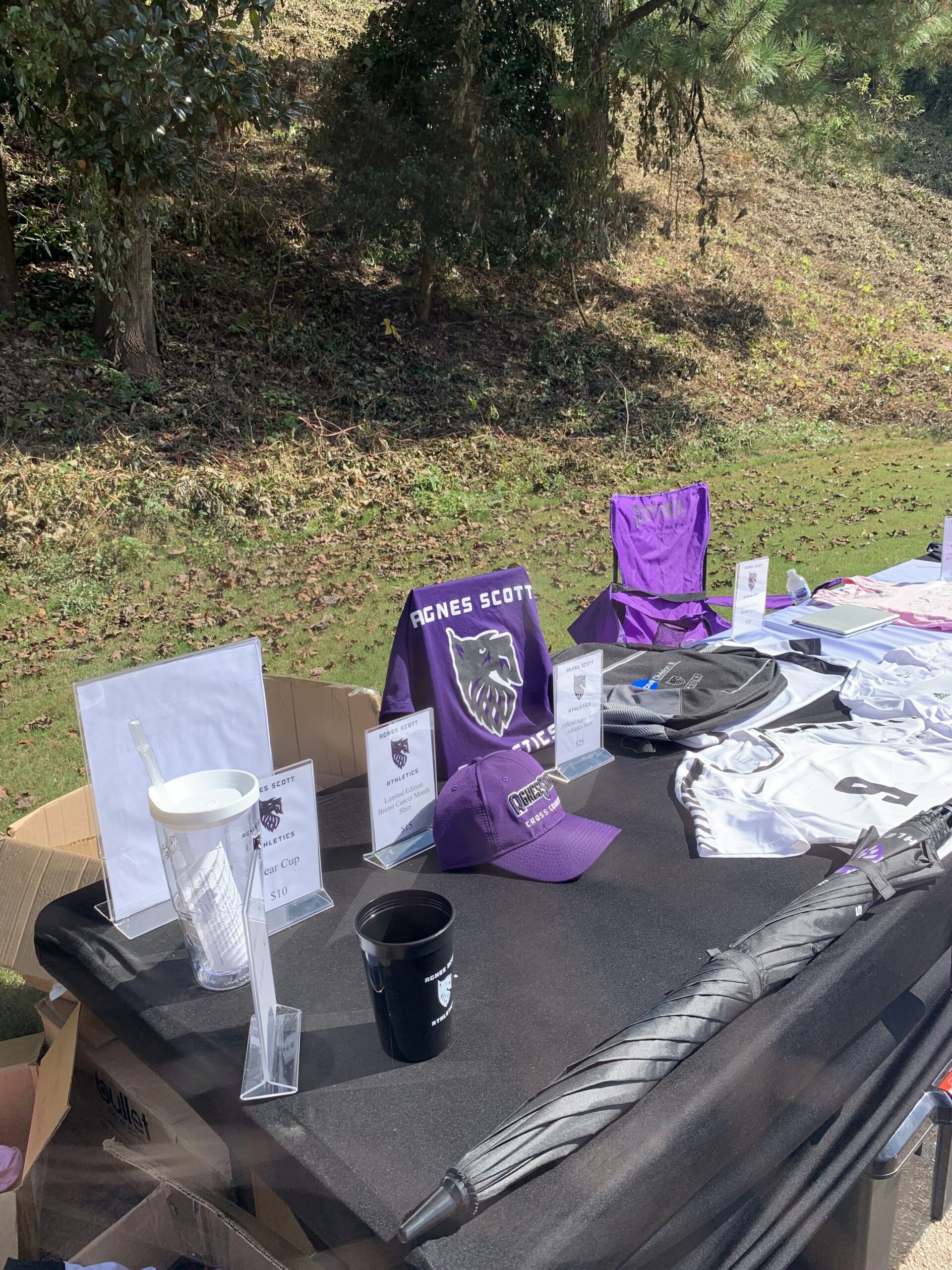
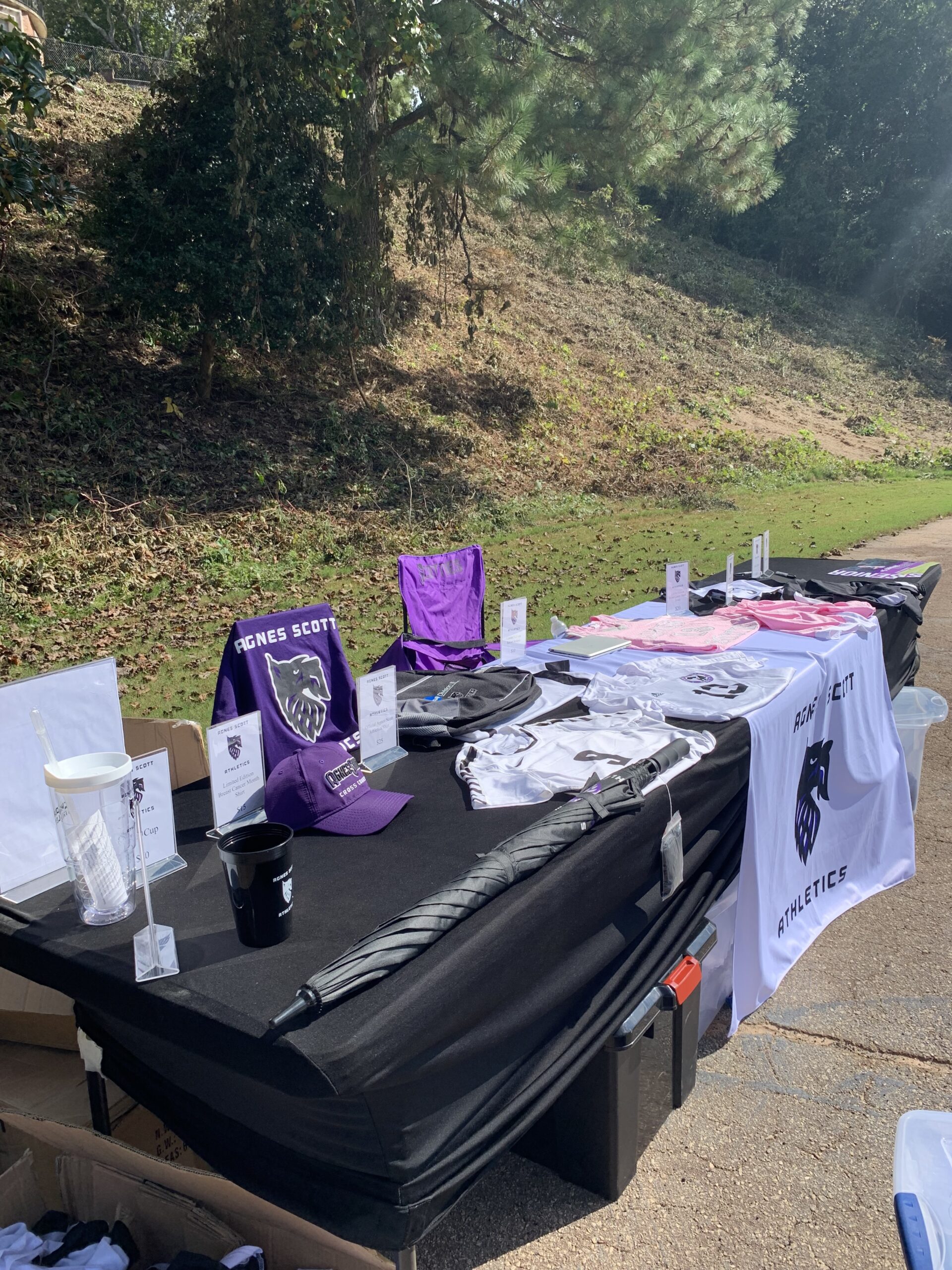
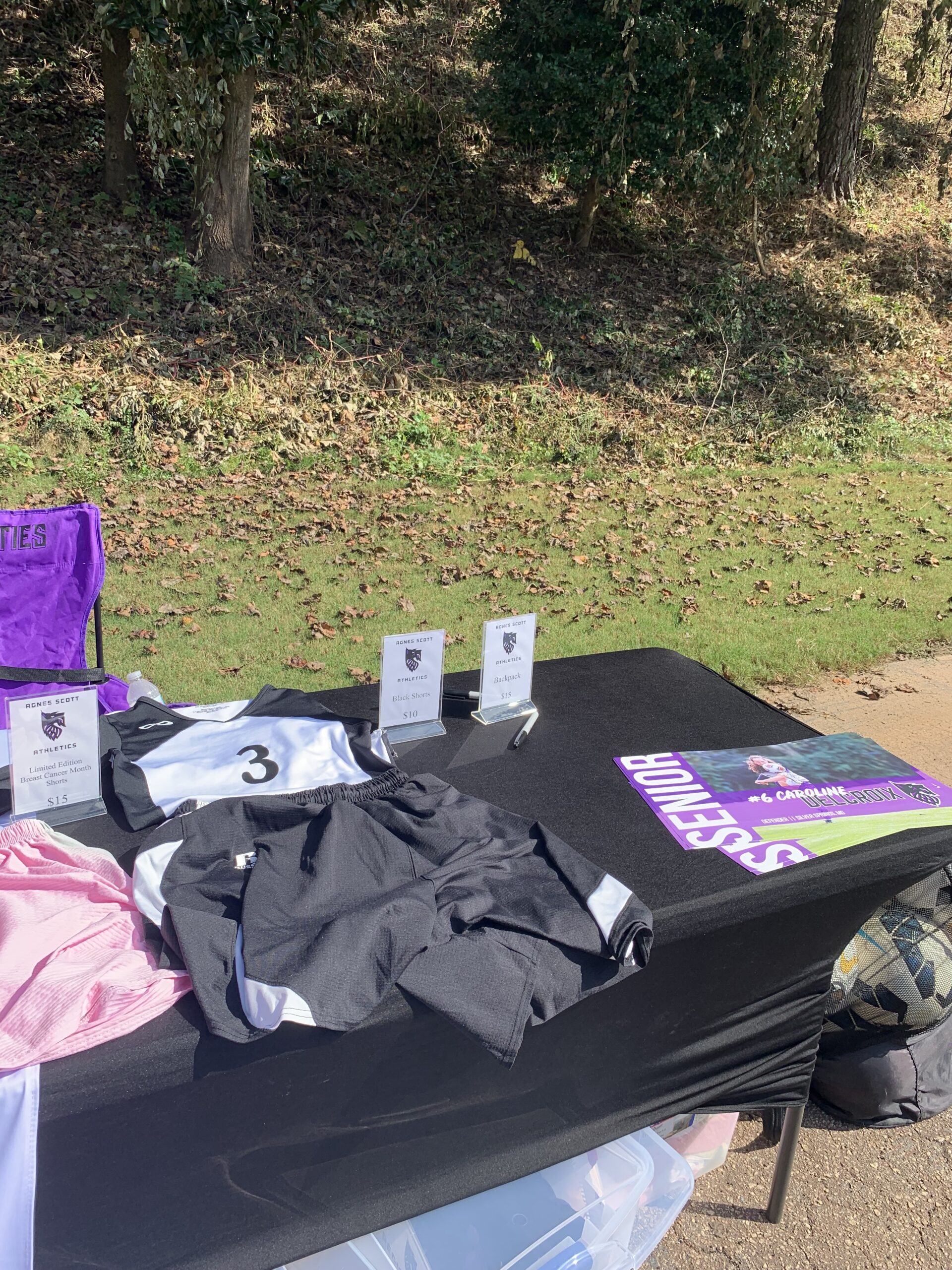
This week I continued to work in the mezzanine and organize merchandise for the upcoming soccer game. I spent hours in the mezzanine choosing inventory. Since breast cancer month is quickly approaching I chose the leftover pink jerseys that were available from years past. I staged my inventory on two tables. I made signage so the customers would know the prices. I had to type them up and print them out myself. I sold the merchandise at the game and learned people do not like dri-fit material and prefer cotton. I also learned that people wanted more hats. People were drawn to the breast cancer gear, but we did not have enough available in enough sizes. Also, people wanted the numbers and jerseys of specific players. Only parents were interested in purchasing goods revealing that the clothes need to be marketed to them. I found all of this information useful. Next time, I want to bring out less inventory and focus on the pieces the parents were drawn to. Below I have attached a picture from the day I sold the goods.
10/3/21
This week we did not meet!
I met with the athletics department and discussed the design plans for 2022. I shared the designs of the sports bra, shorts, sweatshirt, and sweatpants for 2022. The faculty had the opportunity to discuss any designs they had in mind and would like to see in the future. Markesha suggested a screen printing/embroidery option for students to be able to put their numbers/names on jerseys on-demand at games. We also discussed supply chain issues and how goods are taking longer to be received.
I went to Costumes ETC. to find a costume for Halloween. I met a woman named Jane who showed me the back of her warehouse. She had ceilings high of racks of clothes, sewing machines, and bolts of fabric. The room was huge and it had many small rooms containing fabric. She offered me an internship so that I could help her in the store in exchange for her teaching me the fashion business and how to sew.
10/10/21
Fall Break
I took pictures in my Halloween costume.

10/17/21
I watched the film, Proenza Schouler. The film discussed two designers Jack McCollough and Lazaro Hernandez, who founded the brand in their senior year of college after presenting their final project. The name comes from their mother’s maiden names. They became famous for their ability to create garments that were edgy and unique. Throughout the film they were heavily guided by business people who made sure their brand would be lucrative. The Valentino Fashion group acquired 45% of Proenza Schouler. The role of the Valentino fashion group is interesting because I just watched the Valentino documentary. The business component of their brand was the most interesting to me because they had a good business support system. Their designs were not the most interesting to me, but their business identity kept them successful. The emphasis on image was also a priority for the brand. They created shoes that were impossible to walk in and that they knew no one would buy to portray excess and luxury. The designers made an intern work for several days on embroidery on gloves that would not even be seen on the runway showing their obsession with power and control. They did not pay the models any money and they were expected to work without wages. They explained how they could not afford to pay the models and this was seen again in Zac Posen’s documentary. At the beginning of Posen’s career, his model friends volunteered to walk at his first show. The paradigm between the brand reflecting excess and luxury while simultaneously not having enough money to afford models shows the realities of the fashion industry. The designers worked tirelessly with the pattern makers and seamstresses to complete their collections in time for the show. Every fashion documentary I have watched, they are always overworking at the end to complete a collection. I have always wondered why the collections are never done on time. Proenza Schouler did not strike me as being revolutionary or memorable. They have a great business model and that has supported them over the years because they are not a household name. The problems surrounding the brand were the designers’ perception of women. They saw them as devices to be used for their own personal gain. McCollough mentioned how he wanted to be an artist but felt like being a designer was easier. After a model leaves the fitting, Hernandez expresses how if he looked like her he would be mean to everyone because beauty makes her above consequences. This statement is problematic because Hernandez is objectifying the model and believing that her value lies in her appearance. Even the heels they created showed their disconnect from women because they knew they were uncomfortable and impossible to walk in, but they still imposed them on the models. There are scenes where they literally are forcing models’ feet into the shoes. The designers seem to be complicit with exploiting women’s insecurities to trick them into feeling obligated to buy their brand. Overall, I did not like the brand and felt like it was another couple of men imposing their beliefs on women.
Business
I continued to work with Markesha on the games. I worked on another couple of games where I sold goods and got a chance to ask students what apparel they were interested in seeing in the future.
10/24/21
We reconvened and discussed our plan for the last few weeks of class.
Business
I had the opportunity to attend Atlanta Sustainable Fashion week. Agnes Scott sent me the information and paid for my expenses. The event lasted three days.
The first day, Thursday, was underwhelming. I arrived on time but there was so much dysfunction and disorganization that I decided to leave and return the next day.
Friday was better and more organized. I walked around and talked to different designers. I was able to network and meet different people in the industry. I met Nancy who represents FGI Atl. She explained to me that FGI is like the CFDA, but “we do more for our clients”. She discussed FGI having a new chapter in Atlanta, but they are headquartered in NY. She told me they were thinking of forming a board with students on it and she thought it would be good for me to be a part of it. I met Quinay Baker who is the founder and owner of Q & A Fabrics. Q & A designs custom goods from clothes to pillows. She offered me an internship where I could learn how to sew and help her with her company. I met Gynella who owns SELF, a new company that helps designers without a lot of resources learn how to sew and every aspect of the fashion industry so they can be successful. She has her headquarters at Georgia State and teaches classes for $15. She started her relationship with Georgia State in August and she intends to make the company into an agency for designers to have lawyers, business advisors, and other legal guidance to ensure their success and compensation. Lastly, I met a company called Re:loom. Re:loom is operated by Lisa who founded the company to give women of color an opportunity to learn how to weave and earn a living while receiving affordable housing. She told me they received their first loom from Agnes Scott College. She offered me an internship. I was also offered an internship from the owner of Vertical Athletic Wear.
Q&A and Re:loom partnered to create a fashion show of garments that were sustainable using recycled UPS uniforms. I really enjoyed the show.
I also witnessed several smaller designers present their collections.
I got a chance to meet Tanjuria, the creator of the event. She said she appreciated my “tenacity”.
11/1/2021
This week we read the first chapter of Black Designers in American Fashion. This book is an extremely rare find because there is very little documentation of African Americans’ and their contribution to American fashion. I really enjoyed reading the first chapter and I learned so many facts I was never aware of. I never knew how essential African Americans were to the fashion industry in the United States, but it makes sense. Since African Americans’ cultivated the land and produced the garments, it only makes sense that they were the foundation of the entire American fashion industry. Without African Americans’ contribution to the fashion industry in America, it would not exist. I enjoyed learning about Elizabeth Keckley who was Mary Todd Lincoln’s dressmaker. She was also an activist, freedwoman, and author. I also enjoyed learning about how important black people were in the development of textiles and how we have been using them from the beginning of time. I felt a sense of pride reading the first chapter because it confirmed the history of fashion in my ancestry.
I was approached by Dawn Killenberg to help the internship office found a dress for success closet for students to be able to come and find an outfit before an interview. I had an idea to do a fashion show to pilot and bring awareness to the closet.
On Friday I went to my first class at SELF with Gynella where she taught us how to service our sewing machines then how to make the muslin for our tote bags. I really enjoyed the class.
11/7/2021
This week we read the third chapter of Black Designers in American Fashion; it centered on the following three designers: Wesley Tann, Jay Jaxon, and Dapper Dan. I am extremely familiar with Dan, but I had never heard of Tann or Jaxon. Tann was a designer who traveled to New York to further his education after earning his bachelor’s degree at Howard University. Eventually, he started his own line that placed importance on technical designs with beautiful linings. He spent a lot of time giving back to the community and mentoring up-and-coming designers of color. I also enjoyed reading about Jay Jaxon and his contributions to paving the way for people of color to have a place in Parisian fashion. Overall I enjoyed the introduction to two influential designers and their impact on the fashion industry.
I attended the Clothes Minded Summit on Saturday. This was an all-day event that had six speakers lecture about their individual expertise in fashion. The lecturers I enjoyed the most were the fashion lawyer, the fashion designer, and the fashion tech guru. I learned so much information and it was too much to process in one day, but I feel more confident about pursuing my fashion career.
10/14/2021
We read the last chapter of Black Designers in American Fashion. I enjoyed learning about Scott Barrie and how he turned nothing into something amazing. I really enjoyed reading about the evolution of having a small team into an empire. Barrie was extremely intelligent and knew the importance of having a strong business partner. Overall I disliked this chapter the most. It focused too much on the psychological implications of fashion rather than the practice. The author, Tanya Myers, put too much emphasis on what it meant to be a black designer than the actual experience itself. She did not do enough to really do each designers’ lives justice and explain their accomplishments. She spent too much time trying to analyze their characters. I also disliked the fact that the chapters spent so much time talking about men’s contributions. Black women played a dominant role in the consumption and foundation of fashion and the transfer of power to men is alarming. The last two chapters we read focused on men and their contributions while women assumed the role of adornment and objectification.
I visited Re:loom for the first time and was able to see a loom in person. Lisa showed me all of the rooms that were filled with fabric and how the looming process worked. She invited me to come intern, but I told her I would be going to Milan for the next semester. I told her that I would like to remain in contact with her during my journey and resume the role upon my return. I did the same thing with every single one of my internship offers where I explained to them that I would be studying abroad, but I would be returning in the fall.
The samples for the sweatpants, sweatshirts, shorts, and joggers should arrive by the first week of December to prepare for the launch of the Agnes Scott Collection in the Fall.
Markesha also wants me to design the majorette uniforms. Attached are the final designs approved by the majorette team below. Now, I am working with a majorette designer to bring them to life.
Lastly, I want to thank you Dr. Tolliver for taking the time to meet with me and study fashion designers. I learned so much this semester and I feel so much more confident in my fashion history knowledge. I also became aware of what I did not know and I feel more confident in my everlasting quest for knowledge.
I will still be keeping you updated throughout my time in Italy so stay tuned. This is only the beginning.
